As we finish our unit on propaganda, students will be making their own commercials. Please remember to bring in your props.
If you have been absent and have missed assignments, please make sure you see me this week. It is extremely important all missing grades are added to grade book. Report cards go out soon.
We are also beginning a poetry unit. Students are currently working on a Bio/I Am Poem for the Olympics on Thursday.
No vocabulary test this week.
Sunday, March 24, 2013

Sunday, March 17, 2013
Week of 3/18
Happy St. Patrick's Day Everyone!!
The Talent Show was a huge success!! Every act was amazing and I am so proud of everyone. However, it has taken all weekend for this ole body to recover. I might even still be hobblin' around on Monday but that's okay. It was worth it.
We are still working on Advertising and Propaganda. The terms from last week are the same this week and we will have a test on Thursday.
The Talent Show was a huge success!! Every act was amazing and I am so proud of everyone. However, it has taken all weekend for this ole body to recover. I might even still be hobblin' around on Monday but that's okay. It was worth it.
We are still working on Advertising and Propaganda. The terms from last week are the same this week and we will have a test on Thursday.
Sunday, March 10, 2013
Propaganda Vocabulary for the week of March11th
Types of Propaganda
There are
many techniques commonly used in propaganda. Use this handout to help you
identify different types of propaganda.
BANDWAGON: The basic idea behind the bandwagon
approach is just that, "getting on the
bandwagon."
The propagandist puts forth the idea that everyone is doing this, or everyone
supports
this person/cause, so should you. The bandwagon approach appeals to the
conformist
in all of us: No one wants to be left out of
what is perceived to be a popular trend.
EXAMPLE:
Everyone in Lemmingtown is behind Jim Duffie for Mayor. Shouldn't you be part
of this
winning team?
TESTIMONIAL: This is the celebrity endorsement
of a philosophy, movement or candidate. In
advertising,
for example, athletes are often paid millions of dollars to promote sports
shoes,
equipment
and fast food. In political circles, movie stars, television stars, rock stars
and athletes
lend a great
deal of credibility and power to a political cause or candidate.
EXAMPLE:
"Sam Slugger", a baseball Hall of Famer who led the pros in hitting
for years,
appears in a
television ad supporting Mike Politico for U.S. Senate. Since Sam is well known
and
respected in his home state and nationally, he will likely gain Mr. Politico
many votes just
by his
appearance with the candidate.
PLAIN
FOLKS: Here the
candidate or cause is identified with common people from everyday
walks of
life. The idea is to make the candidate/cause come off as grassroots and
all-American.
EXAMPLE:
After a morning speech to wealthy Democratic donors, Bill Clinton stops by
McDonald's
for a burger, fries, and photo-op.
TRANSFER: Transfer employs the use of symbols
to convey a message not necessarily
associated with them. In the use of transfer,
the attempt is to persuade us through the indirect
use of something we respect, such as a patriotic or religious image, to
promote his/her ideas.
Religious
and patriotic images may be the most commonly used in this propaganda technique.
.
FEAR:
The idea is to present a dreaded circumstance and usually follow it up
with the
kind of behavior needed to avoid that horrible event.
GLITTERING
GENERALITIES: This
approach is closely related to what is happening in
TRANSFER
(see above). Here, a generally accepted virtue is usually employed to stir up
favorable
emotions. The problem is that these words mean different things to different
people
and are
often manipulated for the propagandists' use. The important thing to remember
is
that in this
technique the propagandist uses these words in a positive sense. They often
include
words like: democracy, family values (when
used positively), rights, civilization, even the word
"American."
EXAMPLE: An ad
by a cigarette manufacturer proclaims to smokers: Don't let them take your
rights away!
("Rights" is a powerful word, something that stirs the emotions of
many, but few
on either
side would agree on exactly what the 'rights' of smokers are.)
NAME-CALLING:
Name-calling
ties a person or cause to a largely perceived negative image.
Sunday, February 24, 2013
This week in 6th grade Language Arts...
6A and 6B have completed the novel Number the Stars!! Final test will be on Monday.
6C is reading Chains.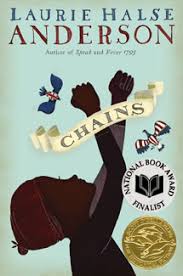
As the Revolutionary War begins, thirteen-year-old Isabel wages her own fight...for freedom. Promised freedom upon the death of their owner, she and her sister, Ruth, in a cruel twist of fate become the property of a malicious New York City couple, the Locktons, who have no sympathy for the American Revolution and even less for Ruth and Isabel. When Isabel meets Curzon, a slave with ties to the Patriots, he encourages her to spy on her owners, who know details of British plans for invasion. She is reluctant at first, but when the unthinkable happens to Ruth, Isabel realizes her loyalty is available to the bidder who can provide her with freedom.
All 6th graders will begin a several week study of Newspapers, Advertising, and Propaganda.
Vocabulary Words for the next 2 weeks:
1. deadline
2. editor
3. feature story
4. headline
5. index
6. inverted pyramid
7. journalism
8. jumpline
9. lead
10. layout
11. flag
12. obituary
13. reporter
14. slander
15. libel
16. caption
17. advertisement
18. classified
19. banner
20. copy
PLEASE send in any old newspapers you may have around the house.

PROGRESS REPORTS COME OUT ON WEDNESDAY! SEVERAL STUDENTS DID NOT DO ASSIGNED PROJECTS. STUDENTS WERE GIVEN AT LEAST 3 WEEKS FOR EACH PROJECT WITH TIME TO WORK ON THEM IN CLASS --SO THERE REALLY ARE NO EXCUSES. THIS WORK CANNOT BE MADE UP AT THIS POINT.
THE NEXT PROJECT IS DUE MARCH 7TH--BLACK HISTORY MONTH BINGO CARDS.
6C is reading Chains.
As the Revolutionary War begins, thirteen-year-old Isabel wages her own fight...for freedom. Promised freedom upon the death of their owner, she and her sister, Ruth, in a cruel twist of fate become the property of a malicious New York City couple, the Locktons, who have no sympathy for the American Revolution and even less for Ruth and Isabel. When Isabel meets Curzon, a slave with ties to the Patriots, he encourages her to spy on her owners, who know details of British plans for invasion. She is reluctant at first, but when the unthinkable happens to Ruth, Isabel realizes her loyalty is available to the bidder who can provide her with freedom.
All 6th graders will begin a several week study of Newspapers, Advertising, and Propaganda.
Vocabulary Words for the next 2 weeks:
1. deadline
2. editor
3. feature story
4. headline
5. index
6. inverted pyramid
7. journalism
8. jumpline
9. lead
10. layout
11. flag
12. obituary
13. reporter
14. slander
15. libel
16. caption
17. advertisement
18. classified
19. banner
20. copy
PLEASE send in any old newspapers you may have around the house.
PROGRESS REPORTS COME OUT ON WEDNESDAY! SEVERAL STUDENTS DID NOT DO ASSIGNED PROJECTS. STUDENTS WERE GIVEN AT LEAST 3 WEEKS FOR EACH PROJECT WITH TIME TO WORK ON THEM IN CLASS --SO THERE REALLY ARE NO EXCUSES. THIS WORK CANNOT BE MADE UP AT THIS POINT.
THE NEXT PROJECT IS DUE MARCH 7TH--BLACK HISTORY MONTH BINGO CARDS.
Thursday, February 14, 2013
Study Guide for rest of the book- Please feel free to print
Chapter Ten: Let Us Open the
Casket
Vocabulary – write what you think the words mean from
context clues
staccato (p.83)
condescending (p.84)
typhus (p.85)
Literal Questions
- Why did the German soldiers come to Uncle
Henrik’s house?
2. What was the first test of Annemarie’s
bravery?
- How did Mrs. Johansen stop the German
soldiers from looking in the casket?
Inferential
Questions
1. Why was Peter’s reading from the Bible so
important?
2. Why did Ellen not smile when she looked at
Annemarie during the fake funeral?
Opinion Questions
- What do you think would have happened if
the German soldiers discovered the truth about the funeral?
2. What do you think is really in the casket?
Number the Stars Vocabulary and Questions
Chapter Eleven: Will We See You
Again Soon, Peter?
Vocabulary – write what you think the words mean from
context clues
encased (p.89)
Godspeed (p.93)
commotion (p.93)
Literal Questions
- What was in the casket and why was it
there?
- Where were the Rosens and the other
strangers going?
Inferential
Questions
1. What did Peter give the baby and why?
2.
What was the purpose of Aunt Birte’s funeral?
Opinion Questions
- Why didn’t Mr. Rosen ask what was in the
package that Peter gave him to take to Uncle Henrik?
2. What is in that package?
Number the Stars Vocabulary and Questions
Chapter Twelve: Where Was Mama?
Vocabulary – write what you think the words mean from
context clues
gnarled (p.97)
gleam (98)
dimness (p.99)
Literal Questions
- What promise did Ellen make to Annemarie?
- What advice on walking the trail did Mrs.
Johansen give the Rosens?
- How did Annemarie pass the time while
waiting for her mother?
Inferential
Questions
1. Explain the following thoughts of Annemarie,
“It was harder for the ones who were waiting, Annemarie knew. Less dangerous, perhaps, but more fear.”
Opinion Questions
- What do you think happened to Mrs. Johansen
on the way back from Uncle Henrik’s boat?
2. Do you think that Annemarie and Ellen will
see each other again?
Number the Stars Vocabulary and Questions
Chapter Thirteen: Run! As Fast As
You Can!
Vocabulary – write what you think the words mean from
context clues
sprawling (p.102)
vast
(p.103)
stricken (p.104)
Literal Questions
- What happened to Mrs. Johansen on her way
back from Uncle Henrik’s boat?
- What had Mr. Rosen dropped at Uncle
Henrik’s house?
Inferential
Questions
1. Why did Mrs. Johansen tell Annemarie to act
like a silly little girl if
she were stopped?
Opinion Questions
- What do you think Mrs. Johansen meant when
she said that “it may all have been for nothing” when she spotted the
parcel?
- Why do you think Mrs. Johansen didn’t tell
Annemarie what she was really carrying to Uncle Henrik on the boat?
Number the Stars Vocabulary and Questions
Chapter Fourteen: On the Dark Path
Vocabulary – write what you think the words mean from
context clues
donned (p.106)
latticed (p.106)
brusque (p.110)
taut (p.112)
Literal Questions
- What fairy tale did Annemarie remember on
the trail to Uncle Henrik’s boat?
- Describe what happened to Annemarie on the
way to the boat?
Inferential
Questions
1. Why did Annemarie choose this particular fairy
tale?
2. Why did Annemarie have to be brave when she
met the soldiers?
Opinion Questions
- How would you have reacted to meeting the
German soldiers?
Number the Stars Vocabulary and Questions
Chapter Fifteen: My Dog Smells
Meat
Vocabulary – write what you think the words mean from
context clues
willed (p.113)
insolently (p.117)
caustic (p.118)
Literal Questions
- What was in the basket that helped fool the
Germans into thinking it was Uncle Henrik’s lunch?
Inferential Questions
1. Why did Annemarie behave like Kirsti when she
was stopped by the German soldiers?
2. Why was it good that Annemarie did not know what
was in the packet?
Opinion Questions
1. Why do you think the German soldiers stopped
Annemarie?
2. Why do you think the contents of the packet
were so important?
Number the Stars Vocabulary and Questions
Chapter Sixteen: I Will Tell You
Just a Little
Vocabulary – write what you think the words mean from
context clues
warily (p.120)
concealed (p.124)
Literal Questions
- What did Annemarie learn about Peter from
Uncle Henrik? What were the two
clues that should have clued Annemarie in about Peter?
- What was Uncle Henrik’s explanation for
each of the following:
- Annemarie not seeing the Rosen’s in the
boat
- The use of a drug on the baby
- The handkerchief
Inferential
Questions
1. What would have happened if Annemarie had not
gotten the handkerchief to Uncle Henrik?
Opinion Questions
1. What do you think life will be like in Sweden
for the Rosen’s?
Number the Stars Vocabulary and Questions
Chapter Seventeen: All This Long
Time
Vocabulary – write what you think the words mean from
context clues
raided (p.130)
rejoicing (p.124)
Literal Questions
- Why was everyone celebrating in Denmark?
- What happened to Peter?
- What
did Annemarie learn about Lise?
Inferential
Questions
1. What does Annemarie wearing Ellen’s necklace
show?
Opinion Questions
- What will the Rosen’s do now that the war
is over?
Wednesday, January 30, 2013
Updated up to Chapter 9--Please feel free to print
Number
the Stars
By
Lois Lowry
Novel
Study
Mrs.
Brindle
Language
Arts
Name ______________
Number the Stars Vocabulary and Questions
Chapter One: Why Are You Running?
Vocabulary – write what you think the words mean from
context clues
contempt (p.3)
sabotage (p.8)
Resistance (p.7-8)
impassive (p.10)
Literal Questions
- Why were Annemarie, Ellen, and Kirsti
stopped by the soldiers?
- What advice did Mrs. Rosen give the girls
about behaving outside?
- How did Annemarie show her dislike of the
German soldiers occupying her country?
Inferential
Questions
1.
Why isn’t Kirsti afraid of the soldiers?
Opinion Questions
- Why do you think the “Free Danes” newspaper
was important in Denmark during the war years?
2.
How would you feel if you were stopped by the German soldiers?
Number the Stars Vocabulary and Questions
Chapter Two: Who is the Man That
Rides Past?
Vocabulary – write what you think the words mean from
context clues
errand (p.13)
trousseau (p.14)
intricate (p.14)
engagement (p.16)
Literal Questions
- What happened to Annemarie’s sister, Lise?
- Why does Peter visit the Johansen’s?
- What are some hardships faced by the Danish
people because of the war?
Inferential
Questions
- How was King Christian different than other
kings?
- Why didn’t the Danish army fight the
Germans when they invaded
Denmark?
Opinion Questions
- Do you think King Christian did the right
thing by surrendering to the Nazis?
- Annemarie believes that ordinary people,
like her, don’t have to be
brave.
Do you agree or disagree with her?
Explain.
Number the Stars Vocabulary and Questions
Chapter Three: Where is Mrs.
Hirsch?
Vocabulary – write what you think the words mean from
context clues
unruly (p.20)
sarcastically (p.21)
swastika (p.21)
torment (p.24)
Literal Questions
- What did Annemarie realize about her friend
Ellen after Peter’s visit?
2. How did Annemarie know the Hirsch’s were not
gone on a holiday?
- What items were being rationed? Why?
Inferential
Questions
- What happened to Mrs. Hirsch?
- Why did the girls always take a different
route to school?
- Explain the following sentence from p. 25
of the novel:
“All
of Denmark must be bodyguards for the Jews….” Annemarie said.
Opinion Questions
- Do you think the Jews were being treated
fairly by the Germans? Why or why
not?
Number the Stars Vocabulary and Questions
Chapter Four: It Will Be a Long
Night
Vocabulary – write what you think the words mean from
context clues
Sophisticated (p.27)
Disdainfully (p.29)
Fleet (p.32)
Synagogue (p.33)
Literal Questions
- How did the Germans find out the names of
the Danish Jews?
- Why was Kirsti upset when she and her
mother returned from shopping? What was Ellen’s solution to the problem?
- What were the “booms and lights in the sky”
on Kirsti’s birthday?
Inferential
Questions
- Why was the Tivoli Gardens important to the
Danes of Copenhagen?
2.
Why would Annemarie and Ellen need to pretend that they are sisters?
Opinion Questions
- Why do you think Annemarie lied when she
said the shoes looked nice?
2.
Do you think it was a good idea for the Johansen’s to let Ellen stay
with them? Explain you answer.
Number the Stars Vocabulary and Questions
Chapter Five: Who is the
Dark-Haired One?
Vocabulary – write what you think the words mean from
context clues
imperious (p.39)
contentedly (p.43)
rationed (p.43)
Literal Questions
- What was Annemarie told about the death of
her older sister Lise?
- Why did the German soldiers come to the
Johansen’s apartment looking for the Rosen’s?
- How did Mr. Johansen convince the German
soldiers that Ellen was not a Jewish girl hiding?
- How did the German soldiers show a lack of
respect for the Johansens?
Inferential
Questions
- Why was it important that Ellen remove her
Star of David necklace?
- Why had Mr. and Mrs. Johansen not looked at
Lise’s things since the
accident?
Opinion Questions
1. What do you think would have happened to the
Johansen’s if Ellen’s true identity had been discovered?
Number the Stars Vocabulary and Questions
Chapter Six: Is the Weather Good
for Fishing?
Vocabulary – write what you think the words mean from
context clues
tentatively (p.50)
distorted (p.55)
exasperation (p.57)
Literal Questions
- Why were the girls kept home from school
after the visit by the German soldiers?
- What made Annemarie realize that her father
was speaking in code to her uncle?
What was their conversation really about?
- Where did Mrs. Johansen, Annemarie, Kirsti,
and Ellen travel? Why didn’t Mr.
Johansen go with them?
- Compare the area around Uncle Henrik’s farm
in Gillelege to the Johansen’s apartment in Copenhagen?
Inferential
Questions
- Why was Annemarie worried when the soldiers
questioned them on the train?
2.
Why did they travel to Uncle Henrik’s house?
Opinion Questions
1. Why do you think the Danes spoke in code
words?
Number the Stars Vocabulary and Questions
Chapter Seven: The House By the
Sea
Vocabulary – write what you think the words mean from
context clues
awe (p.60)
hazy (p.62)
appliqued (p.65)
Literal Questions
- What was the name of Uncle Henrik’s boat
and where did he get the name?
- What did Annemarie do with Ellen’s
necklace?
- Why did Mrs. Johansen tease her brother
Henrik?
Inferential
Questions
- What does the sea represent for Ellen and
her family?
2.
Why did Mrs. Johansen ask the girls if they saw anyone while playing
near the shore?
Opinion Questions
1. Why do you think there was no laughing
between Mrs. Johansen and
her brother as they sat down to talk?
Number the Stars Vocabulary and Questions
Chapter Eight: There Has Been a
Death
Vocabulary – write what you think the words mean from
context clues
relocate (p.68)
mock (p.71)
dismay (p.71)
Literal Questions
- How did the girls spend their full day at
the farm?
- How did Annemarie make fun of the German
soldiers?
- Why was Annemarie surprised by Uncle
Henrik’s announcement that there was to be a funeral?
- What is the old custom when someone
dies? What did the family have to
do to prepare for the funeral?
Inferential
Questions
- Why is Annemarie so delighted to have
oatmeal, milk, cream, and butter at breakfast?
- What did Uncle Henrik mean when he said, “Tomorrow
will be a good
day for fishing”?
Opinion Questions
1.
Why, when his sister and his nieces were visiting, would Uncle Henrik
spend the whole night on his boat?
Number the Stars Vocabulary and Questions
Subscribe to:
Posts (Atom)